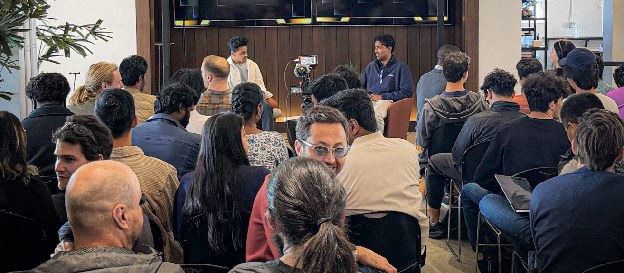
A talk on Startup Principles in the Marina District, San Francisco.
“Enjoyed reading through your startup principles” — General Partner at $15B AUM Venture Fund, lead investor in companies like Dropbox, Slack, Figma, Scale, Notion, Confluent, Roblox, Etsy, Discord, Robinhood, Stripe, Adyen, Wiz and more
“Loved your startup principles” — Managing Director and CEO of $70B AUM Venture Fund, lead investor in companies like Rippling, Harvey AI and CoreWeave
“Wholeheartedly agree that great companies have theologies” — Managing Director at $1.2B AUM Venture Fund, investor in companies like Relativity Space, PsiQuantum and MosaicML
“Love your startup principles doc” — Partner at $2B Fund, investor in Uber, SoFi and Augment
“Your principles are so good” — General Catalyst Series B Founder
“You could publish them to Kindle as an e-book and I would be happy to buy it. I used to work for Palantir and am a former colleague of some of your colleagues.” — Palantir and Anduril Mafia Member
“I thought your startup principles doc was so cool (and helpful)” — Agency that does comms for companies like Anduril, Ramp and Cognition
“Love your writing on startups and your writing generally” — Thiel Fellowship finalist, a16z Investor, ex-Stanford
“Abhay, I really enjoy your principles, especially the resources where they're derived” — Founder, ex-CMU
“Really enjoyed reading your startup principles” — StanfordAILab, Stanford
“This doc is super cool” — Founder
“Your Startup Principles have been a huge inspiration to me as I build my own startup.” — Founder
“Just wanted to say excellent talk and really well thought out and articulate startup principles which really resonate with some of the top startups” — Startup Investor
“read your Startup Principles, liked it” — Founder
“Loved reading your startup principles!” —Engineer at Midjourney
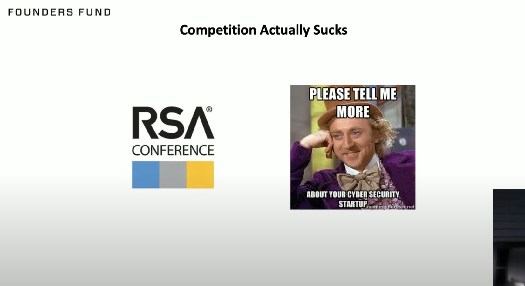
Circulated by GP of Founders Fund
“Your startup principles are really well written, we circulated it among our office” — Multi-Family Office of Founders and VCs backing companies like Anduril
They are very likely to in fact be distributed according to a power law, where one of the three variables are likely to dominate the other two.
Principle-1-example-2: perhaps in the case of OpenAI, the team was stupidly good already a few years ago before there was any product or market identifiable.
Principle-1-takeaway-1: so it is very important to decompose the startup into its respective components and identify the dominant factor before making an investment[6]
Principle-1-caveat-1: if one had to pick, the founder is always the dominant variable, but it's often hard to read the founder without reading the market or product[7]
Principle-1-related-principle-4: the upper bound on an institution is set by the founder
Principle-1-elaboration-1: Often markets are able to create founders because markets have a natural pull to them and can give founders a better outcome than they deserve[8]
While also making it seem like it was the genius of the founder
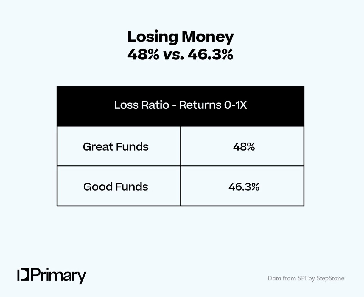
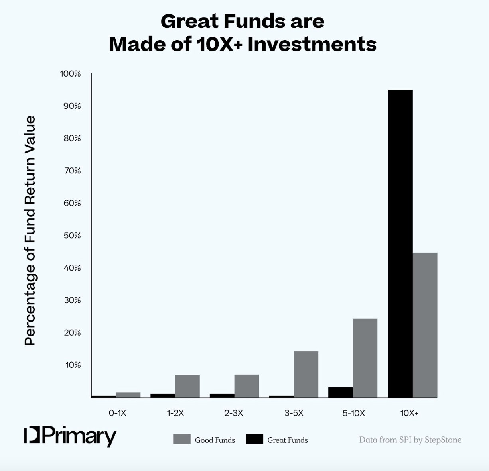
Principle-4-takeaway-1: every single company in a good venture portfolio must have the potential to succeed at vast scale
Principle-4-takeaway-2: hence, the best venture capitalists in the world are those that have generated $1B+ of cash distributions from a single investment more than once[16]:
1. Bill Gurley - Benchmark
2. Fred Wilson - Union Square Ventures
3. Michael Moritz - Sequoia Capital
4. Danny Rimer - Index Ventures
5. Jim Goetz - Sequoia Capital
6. Alfred Lin - Sequoia Capital
7. Peter Fenton - Benchmark
8. Jan (Yan) Hammer - Index Ventures
9. John Doerr - Kleiner Perkins
10. Chris Sacca - Lowercase
11. Peter Thiel - Founders Fund
12. Mary Meeker - Kleiner Perkins
13. Vinod Khosla - Khosla Ventures
14. Neil Shen - Sequoia China
15. Mark Stevens - Sequoia
16. Lee Fixel - Tiger
17. Jeff Jordan - a16z
18. Keith Rabois - Khosla / FF
(maybe more here)
Principle-4-application-1: if you are managing a fund that is around a $B, the only thing that matters is getting a $10B+ category defining winner[17]
Principle-4-application-2: “differences between companies dwarf differences between roles within companies
You could have 100% of the equity if you fully fund your own venture, but if it fails you’ll have 100% of nothing. Owning just 0.01% of Google, by contrast, is incredibly valuable (more than $35 million as of this writing)[18].”
Principle-4-example-1: Founders Fund Portfolio
From 2004-2021, 15 years
Invested in 350 companies
10 of those companies have produced 95% of all the returns
The top two percentile of companies within the fund produced 95% of all the returns
Principle-5-exception-1: when there are constraints, such as constraints of growth, constraints of energy, and other limitations
Principle-5-exception-1-example-1: human height follows a normal distribution because of biological constraints
Principle-5-example-1: markets don’t have constraints
so therefore they follow a power law
Principle-5-corollary-1: time and decision-making follow a power law[20]
Principle-5-corollary-1-example-1: Peter Thiel would often believe that his job as a CEO was to make one good decision per year[21]
Principle-5-corollary-1-example-2: every decision that isn’t a “hell yes” is a bad decision
The moment you start making a pros and cons list, you’re setting yourself up for failure[22]
Principle-5-related-principle-1: @AbhayVenkatesh1 · In power law domains like startups, research or universities, it is better to not do something than do it mediocrely[23].
Conversely, in many linear domains, like being an employee at a big tech company,
you're not incentivized for working harder than you have to, because your upside is hard capped.
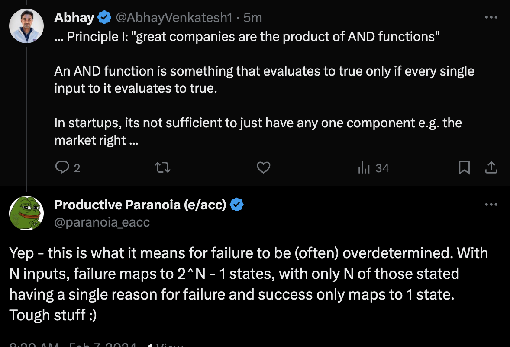
Principle-6-definition-1: Definition of overdetermined:
"To determine, account for, or cause something in more than one way or with more conditions than are necessary."
“Most businesses fail for more than one reason. So when a business fails, you often don't learn anything at all because the failure was overdetermined. You will think it failed for reason 1, but it failed for reasons 2 through 5. And so the next business you start will fail for reason 2, and then for 3 and so on[24].”
Principle-6-takeaway-1: it's hard to learn from failure because it's unclear to know what precisely went wrong
Principle-6-takeaway-1-example-1: let’s say you fail in your startup and determine that the reason you failed was the team.
Next time, you fix the team, but then you fail again because you didn’t realize that you also didn’t pick the right market and product
Principle-6-takeaway-2: if you do want to learn from failure, you must overcompensate[25]
That is, you must fully enumerate the causes of failure, and not just correct for one of the many[26]
Principle-6-takeaway-2-example-1: let’s say you fail in your startup
This time, instead of merely just attempting to correct one thing, you overcompensate and try 10x harder than before
You act paranoid and not just correct the team, but are also airtight on market and product and so on
Principle-6-related-principle-1: In aviation the term “Error Chain” refers to the concept that many contributing factors typically lead to an accident rather than one single event causing the accident[27].
Principle-6-takeaway-3: often the right thing to do after failure is to just forget about it and move on.
In simple terms, this means that trying to figure out the truth is much harder than experimentation
Principle-7-example-1: we figured out how to fly not by mathematically proving the laws of flight, people like Howard Hughes just experimentally tried out flying many different types of planes, and we figured out from the data what the laws of flight were
Principle-7-takeaway-1: some level of experimentation is necessary is startup investing and construction
Principle-7-takeaway-1-example-1: instead of focusing on making sure that you get the right company in your first investment, opt for a portfolio strategy where you are making relatively cheap bets to buy outsized outcomes
Principle-9-reasoning-1: “Software has zero marginal cost, so the company with the most revenue can invest the most upfront into making a better product, giving it even more revenue.
Furthermore, in most cases there is little incentive for customers to ever use the second best product in a segment.
So when building software, you not only have to meet the customers needs, you have to meet the customer needs better than any competitor.
If you produce a product that is half as good or improve the product half as quickly, you do not lose just half your revenue, you could lose all of it.”
Principle-10-exception-1: A company can sometimes be re-founded through a decisive leadership, ownership, or narrative reset
Principle-10-exception-1-example-1: Facebook was re-founded by the replacement of Eduardo Saverin.
Principle-10-corollary-1: since foundings are categorically special, it is possible to execute a play in the tradition of Thiel, Lonsdale or Altman where the co-founder takes equity without participating in the execution of the enterprise[33].
Principle-10-corollary-2: since there is so much information lodged in the founding of companies, great companies are often pre-ordained to succeed[34]
since there are far more ways to fail than there are to succeed, you actually don’t learn much from failure[39]
so success effectively means having to find success as soon as possible and not “failing fast” or “failing as much as possible to stumble into success by accident”, which will never happen
Principle-13-takeaway-1: so when making a decision, if you cannot identify the dominant variable, it might reflect the fact that you haven’t looked hard enough
Startups are a game of outliers. And so the way you win here is not by trying to patch your (non-catastrophic) weaknesses, but by rather going all-in on your strengths[42]
Principle-14-reference-1: “you last in this game by figuring out what you are better at than everybody else and leaning in on that indiscriminately[43]” - Brian Singerman
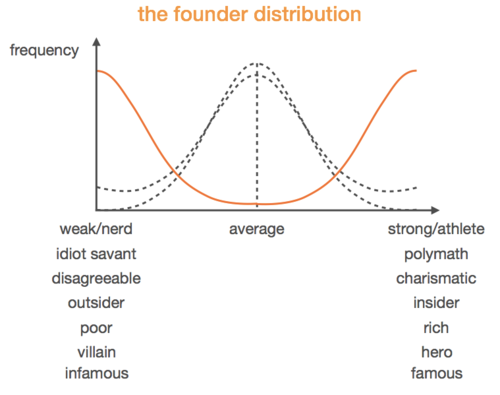
Principle-14-related-principle-1: great founders have inverted normal distribution of traits[44]
Do you want to be CEO of Google or do you want to be CEO of Sullivan & Cromwell?
"The perfect business for me is getting paid a tremendous amount of money for your words, just your advice. I really do think the old-school merchant banks and M&A boutiques like Lazard and Allen & Co. and some of these places are pretty close to the perfect business, where someone has decided that your wisdom is so worthy that they're just going to give you hundreds of millions of dollars for it. These businesses require no capital. They're hugely cash flow accretive."
"I think that will be close to the perfect business because I guess what I'm after is leverage and the idea of basically being able to be compensated super highly for your words is pretty close to just speaking money into existence, which I think is very close to the perfect business."
This is because great companies are great answers to the question: what important truth do few people agree with you on[59]?
So when you start a great company, most people should disagree with you (but not necessarily all tier 1 VCs who are trained to look for such companies)
Principle-19-related-principle-2: when you are doing something contrarian and right, there is often room for extreme misinterpretation on the outside[60].
“the bitter truth about startup investing is that momentum investing actually works” - Peter Thiel[61]
“The best companies are often the best companies at every stage, its very rarely the case that a company is not working at all until it suddenly does” - Trae Stephens[62]
Principle-20-caveat-1: companies like OpenAI might have had no revenue for a long time, but they’ve had momentum in other dimensions the entire time (e.g. very clear research output consistently).
Principle-20-conclusion-1: since momentum is everything in startups, venture capital at the tier 1 level is anti-commoditized because the signaling value of the tier 1 investor is priceless
Principle-21-application-1: in analyzing startups, it makes a lot of sense therefore to drill down on the “line of sight to success”[66]
Principle-21-related-principle-1: If you think you’re going to get an A, you may or may not get an A. If you think you’re going to get an F, you will almost certainly get an F.
“There are no secrets in venture capital” - Trae Stephens
Principle-23-caveat-1: The big opportunities are obvious when you see them... but you have to actually see them[70].
Principle-23-corollary-1: There are only 5-10 companies that matter at any given point of time. And all that matters is participation in one of them[71].
great companies not only provide exceptional financial compensation in the form of equity, but also provide psychological compensation in the form of startup myths[73] such as AGI, Space, Decentralization, Climate or America[74]
Principle-24-related-principle-1: great companies are cults[75]
Principle-24-related-principle-2: great founders are prophets[76]
Principle-24-related-principle-3: “Successful people create companies. More successful people create countries. The most successful people create religions”[77]
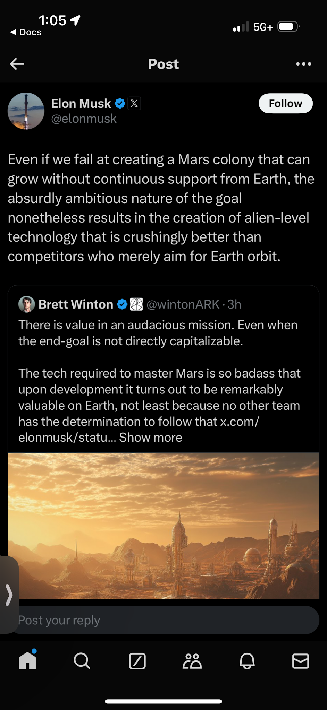
E.g. defending America, going to Mars and building AGI
Are we ever really finally going to perfectly “defend America”? Are we ever actually “going to Mars”? Don’t we always perpetually shift the goalposts for what “artificial intelligence” means?
But people believe these missions and are willing to invest great amounts of self-sacrifice towards them
E.g. SpaceX combines the greatest hope for man — space travel, “SpaceX mission is to go to mars / explore the universe” — with extinction — “Earth is a single point of failure”
What happens in 5 years from now depends on what happens today.
Someone who made the right decision today will benefit from a dramatically different opportunity space 5 years from now[83].
Principle-27-takeaway-1: this means that major life decisions such as job or career changes have a tremendous influence on everything that happens next in your life.
So it is paramount to ensure that each decision is made optimally and that you don’t do a random walk.
Principle-27-application-1: choose projects such that if they succeed, they would make the rest of your career look like a footnote[84]
Principle-27-takeaway-2: be willing to take as much time as necessary between projects, it's more important to pick the right project than to pick a project.
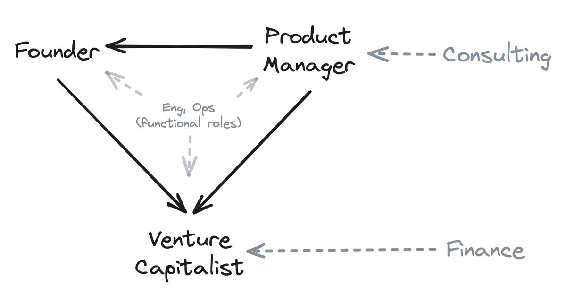
Principle-28-corollary-1: the best founders in the valley are those that don’t call themselves founders, the best product managers are those that don’t call themselves product managers and the best VCs are those that don’t call themselves VCs
Principle-31-example-1: in a product organization, you both need to data-driven method of measuring usage, and also the top-down creative endeavor of telling users what they want
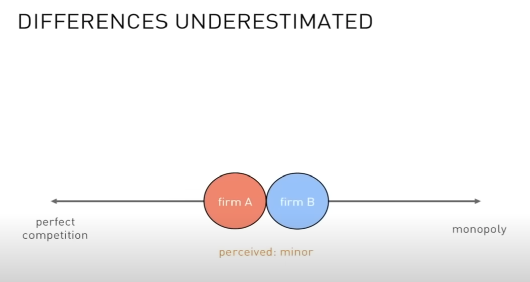
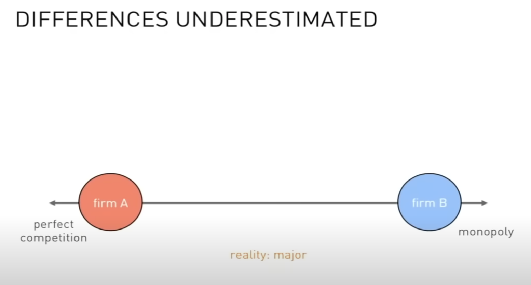
Because there are really only two types of businesses: monopolies and non-monopolies, it means that once a monopoly is established, it cannot be re-established again.
Which means every moment in business happens only once: the next Zuckerberg won’t start a social network, the next Gates won’t start an operating system, and the next Musk won’t start a rocket company.
“You did not make any money in crypto if you did not invest in Coinbase, you did not make any money in social networks if you did not invest in Facebook and you did not make any money in sharing economy if you did not invest in AirBnB” - Trae Stephens
Some caveats here, there are usually a few winners outside of the big ones e.g. Bitcoin, Ethereum and Solana in Crypto, Snap, Twitter and Instagram in Social Media, and Uber in sharing economy
But it is never dozens — it’s effectively 1-3 winners — still very much “power law”
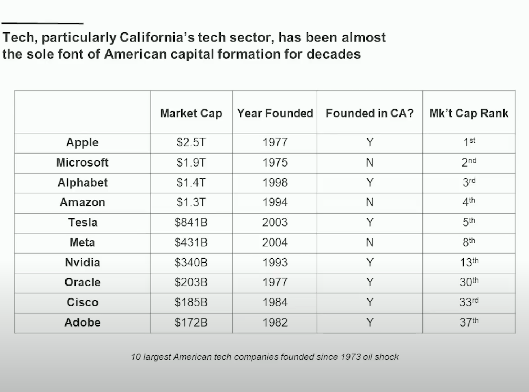
Startups is all about being in one of these one-of-a-kind businesses
Principle-39-related-principle-1: Great companies initiate technological waves (or even bubbles)[99]
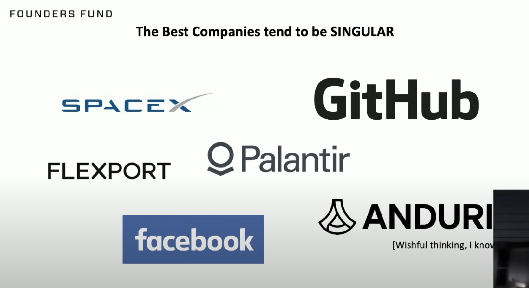
Anduril started American Dynamism, OpenAI started Generative AI and Facebook started Social Media
For example, Anduril was found at the intersection of edge AI, deglobalization and the End of SaaS[100]
“I think the biggest competitive advantage in business—either for a company or for an individual’s career—is long-term thinking with a broad view of how different systems in the world are going to come together[101].“
Anduril originated out of the Thielosophere, OpenAI originated out of the rationalist sphere and Physical Intelligence originated out of the Stanford AI research community
When you start hearing the same request repeatedly
That’s when you know you need to satisfy the request
If you are not hearing requests, then you need to initiate a scene[111]
Begin the conversation
And then let people fill in the blanks
Proof of work
Startups are responses to requests from the center
Principle-46-related-principle-1: startup formation is not purely bottom-up; it is shaped heavily by elite capital, talent networks, and social proof[112]
Thanks to Jon Goldsmith and others for their feedback on revisions of this document. Thanks to Zack Baker and others for the inspiration and ideas for so many of the principles here.
“Is the venture in which the investment is proposed managed by people of outstanding competence and integrity (page 162 from VC: An American History)?” ↩
Elite law firms demonstrate that the most durable monopolies in modern capitalism are often professional service institutions rather than software platforms. For example, Kirkland & Ellis generates approximately $8.8B in annual revenue with ~60% profit margins (founded 1909). Latham & Watkins produces roughly $7B in revenue with ~56% margins (founded 1934). Sullivan & Cromwell, founded in 1879, generates approximately $2.1B at ~58% margins. Cravath, Swaine & Moore, founded in 1819, produces roughly $1.2B at ~51% margins. These firms have sustained 50–60% profitability for decades without technological scalability, relying instead on institutional reputation, credential control, and embedded elite networks. Unlike software platforms, which often depend on transient technological paradigms, these firms have survived for over a century while retaining pricing power and control over high-value transactions. ↩
According to Straussian Hermeneutics, truth and society may sometimes stand in tension. A taboo can indicate many different things: moral danger, social instability, factual uncertainty, institutional self-protection, or simply bad epistemics. The fact that a topic is difficult to discuss should not be treated as proof of its truth, but as a reason to investigate with unusual care, precision, and moral seriousness. ↩
The startup ecosystem is usually described as a bottom-up order: founders discover needs, build products, and markets decide. This is true at one level of description. At another level, however, no company of consequence becomes fully real until it is recognized by the institutions capable of granting it social, financial, and symbolic legitimacy. Capital here is not only fuel; it is also a rite of recognition. ↩
“The Originary Scene is a hypothetical scene of origin of the human in which a group of mimetic hominids discover/invent language (via a non-verbal gesture) as a solution to a potential mimetic crisis.” — Introduction to Generative Anthropology↩