
July 28, 2026. Originally published as an article on X, where discussion continues. A follow-up, Requests for Startups, lists gaps worth closing.
Don't make something people want, make something the system needs[1]
It is customary to describe startups as bottoms-up phenomena. The concept itself "start-up" seems to suggest that you start (from the bottom), and go up. We're all familiar with the "startup myth" (it is funny that they all seem to start in the exact same way). An eccentric founder in a garage. They have a brilliant idea—the light bulb moment—and by sheer force of insight or persistence, the idea propagates outward until it reshapes the world. Unfortunately, this story is appealing not because it is true, but because it flatters our modern, post-enlightenment[2] self conceptions: that merit is self-certifying[3].
There is a sense in which "myth" isn't entirely false[4]: new companies do begin small, founders do have ideas[5], and users are consulted. And yet, at the same time, the story fails to account for a striking regularity: that enduring companies rarely emerge without early recognition from a narrow set of institutions whose approval appears neither accidental nor evenly distributed.
For example, how does one explain the strange phenomenon of respected figures in the startup world often providing contradictory advice? One camp of figures have long insisted on the need to obsessively talk to users. However, some counsel the opposite, that one must take a more Steve Jobs-like approach of having an ESP-link to the users[6], or even better, telling the users what they want. The truth can't be both A and not A at the same time. So maybe the "advice" points to something entirely orthogonal.
What is consistent about successful startups, therefore, is not the method, but the presence of recognition. At some point, often early, sometimes invisibly, the project is judged as legitimate by actors whose judgment has consequences. This recognition need not be public, unanimous, or even articulated. It is sufficient that it exists.
Legitimacy[7], in this sense, is not created by users, and neither is it fully manufactured by founders[8]. It is conferred, directly or indirectly, by institutions that already possess it. Venture capital firms are one such layer, but they are not the origin. Their authority too, is borrowed.
Without dwelling into too many details, here is the rough framework of legitimacy:
The institutions[11] at the top of the food chain have broad mandates; they're less concerned about the shape of the next iPhone and more about the future of civilization[12].

From this perspective, building a company is less a matter of discovering what individuals want than of aligning with needs that are rarely spoken plainly. To create a truly massive enterprise, you need to be thinking on the systemic level. These needs arise when the structure of the social order as we know is under strain, and when no established institution can respond without exceeding its mandate. The gap that opens is not immediately visible as a "market" but felt more as a pressure[13].
The successful founder does not invent this pressure. He encounters it, often indirectly, and often without fully understanding it. To this extent it makes sense to "listen to users", to the extent that you're attending to pressures that surface first at the periphery, but originate from deeper structural constraints[14]. I call this pressure sovereignty gaps: situations in which the central structures of society require a function that they themselves cannot perform, and therefore tolerate—and in some cases give rise to conditions that permit—the emergence of new actors ("founders") to perform it on their behalf.
In liberal political orders, these gaps often arise not because the state lacks the desire to perform a function, but because it cannot perform that function directly without exceeding its legal, political, or institutional remit. A company can coordinate private property, capital, labor, and information in ways that formal public institutions cannot. The company does not simply replace the state. It becomes an indirect institutional form through which a required sovereign function can be executed.[15]
It is worth clarifying the scope of the argument. Not every successful company is the direct result of a sovereignty gap, nor does the framework claim that all valuable businesses arise from such conditions. Many companies achieve meaningful scale by improving local efficiency, serving narrow verticals, or exploiting temporary technological asymmetries. These outcomes can be substantial, and in some cases highly profitable.
The claim here is narrower and stronger: the largest, most durable, and most systemically consequential enterprises tend to emerge where sovereignty gaps are present—whether addressed directly or indirectly. In practice, many firms that appear non-sovereign are better understood as derivative infrastructures, supplying coordination, tooling, or surplus capacity to actors engaged in resolving deeper structural demands, e.g. Slack is used by Palantir, a company directly plugging a sovereignty gap. Others succeed by operating downstream of gaps already being addressed elsewhere. The distinction is therefore not between "real" and "fake" companies, but between enterprises that resolve local inefficiencies and those that stabilize or reconfigure the social order itself.
That every great company is a plug to a sovereignty gap is an uncomfortable idea, and undoubtedly invites skepticism. It appears to diminish the role of creativity, ingenuity, and the independent fearlessness of individuals to drive change in history. That's not my intention. All of those still matter. My argument is more about how those energies should be channeled, and I think the way in which it normally is, is woefully misguided.
Before dismissing this contrarian account of startups, let us examine some examples.

The standard history of Google goes something like this: two Stanford graduate students and an "unofficial third founder," Scott Hassan[16], tinkering away on a research project to index the internet[17]. A classic "garage startup" myth; strangely identical to every other Silicon Valley origin story.
But what if this is mostly the wrong causal explanation? What if Google emerged not purely from tinkering but from addressing a yawning sovereignty gap: the explosive growth of the early internet—effectively a civilization-scale information substrate—that had created a massive, unmet requirement to make the data on this system navigable and searchable? In this view, PageRank was not merely a whimsical hack; it was an answer to a structural absence.
How did they find out about this sovereignty gap? While causal attribution is necessarily incomplete, Brin and Page[18] were situated within research ecosystems that were shaped by prevailing research priorities and funding structures of the period[19]. Whether or not this exposed them to the sovereignty gap directly, it certainly placed them near it[20]. As a consequence of plugging this sovereignty gap, they created one of the most robust monopolies of all time.
Another classic Silicon Valley story is the story of Facebook. How did it start? Apparently it was just a nerdy guy at Harvard who wanted to get laid. So he made this company. That may well all be true, but there are hundreds if not thousands of nerdy guys at Harvard who also want to get laid but don't end up starting a trillion dollar company.
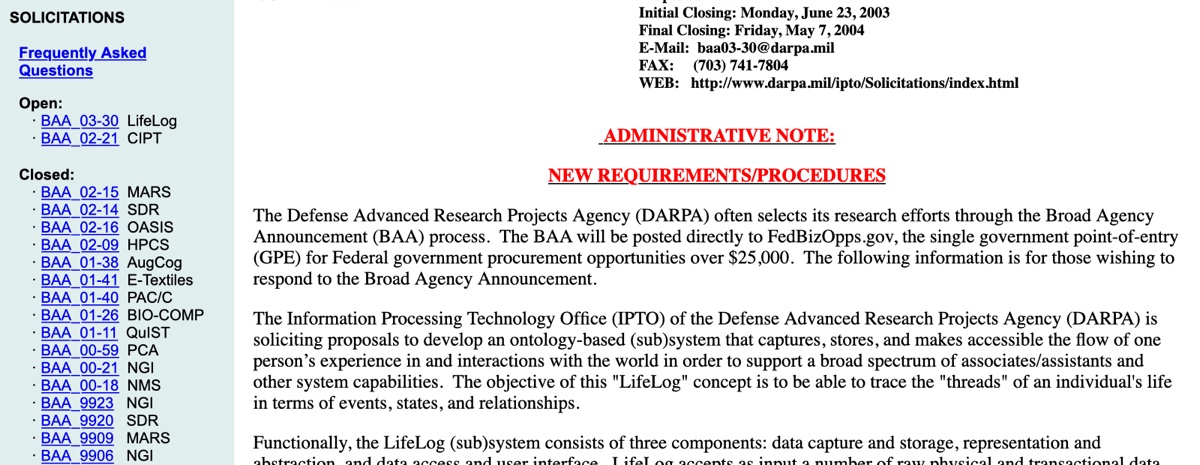
What made Facebook different from the dozens and dozens of other hackathon projects that emanate from Stanford, MIT, or Harvard is that it addressed a sovereignty gap: the informational visibility gap created by the early internet. There is a strange phenomenon of DARPA LifeLog[21], a project that "captures, stores, and makes accessible the flow of one person's experience in and interactions with the world in order to support a broad spectrum of associates/assistants and other system capabilities". The period also coincided with the winding down of several ambitious state-led attempts to formalize large-scale social data collection[22].
We pick the examples of Google or Meta[23] which are a lot less obvious than the examples of SpaceX[24], Palantir[25], or Oracle[26] (or even Apple, Microsoft, or OpenAI[27], or even Bitcoin[28])[29].
Sovereignty-gap companies frequently possess two products at once. The exoteric product is the one presented to users: search, maps, social connection, transportation, payments, or convenience. The esoteric function is the systemic capability created underneath: information retrieval, population legibility, geographic intelligence, labor coordination, identity, or financial control. The consumer product supplies legitimacy and distribution; the sovereign function supplies durability and power.
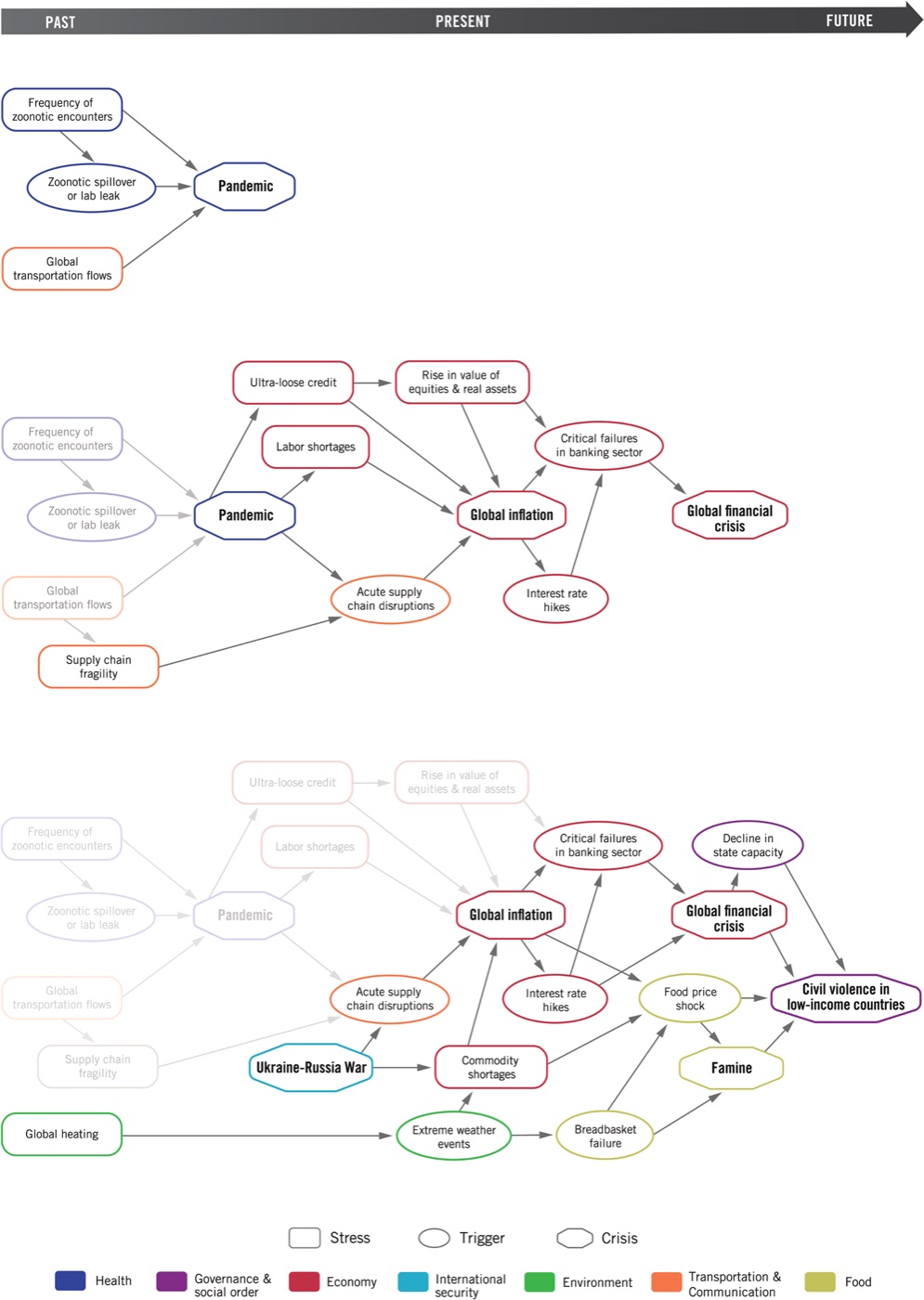
One way to find sovereignty gaps is to think in terms of "crises". You could think in terms of the housing crisis, climate crisis, pension crisis, debt crisis, or fertility crisis. Or perhaps yet another set of crises will emerge as part of the biggest technological changes. In our time, that is AI.
More generally, identifying sovereignty gaps requires attentiveness to systemic pressure rather than explicit demand[30]. Large gaps rarely announce themselves as opportunities; they are first experienced as tensions—coordination failures, silent breakdowns, or chronic inefficiencies that everyone privately recognizes but few can articulate clearly. These pressures tend to surface unevenly, often at the periphery, before becoming legible at the level of policy or markets.
These pressures are communicated by the center[31]—the shared focal point of a society—the locus[32] where attention, norms, authority, and coordination converge. It is not a single actor or institution, but the structural point around which the social order stabilizes. When strain accumulates at this locus, the resulting pressure is felt system-wide, long before it is formally acknowledged. Sovereignty gaps arise precisely in these moments, when something essential must work for the system to hold together, yet no existing institution can address it without exceeding its remit.
Detecting a sovereignty gap is not merely a matter of brainstorming or ideation. Startups created purely at the whiteboard tend to fail. Instead, it is something closer to refining perception, a way of listening to reality and figuring out what is off. Sovereignty gaps announce themselves through a kind of background hum: rising tensions, silent failures, things everyone privately feels but cannot publicly articulate[33]. To sense these cracks, you cannot rely on frameworks or idea-generation hacks; you must train yourself to notice the subtle dissonance between what the system appears to be doing and what is actually being demanded of it.
So rather than trying to "come up with a startup idea," the more reliable approach is to attend to these pressures and ask what function is missing. If Google was created in response to the data search crisis that came out of the internet, what company would be created in response to the crises emanating due to AI? That company may end up being the largest company of all time.
Some examples of AI crises may be: mass psychosis, mass job loss, population control (or loss of it thereof), proliferation of AI weapon systems, geopolitical instability, cyber instability, financial instability due to centralization of the economy on AI, and more[34]. These may very well be unaddressed sovereignty gaps that will be plugged by the next Zuckerberg.

I would like to thank John Luttig, Jon Goldsmith, Sebastian Caliri, Alexa Liautaud, Taggart Bonham, Aashay Sanghvi, Selina Wang, Bryan Offutt, Christina Stankey, Dan Robinson, David Song, John Suh, Arjun Das, Michael Tan, Sami Senapathy, Aden Clemente, Aadi Saha, Varun Shenoy, Theo Marcu, Divya Gupta, Tina He, and others for their feedback on this document. Thanks also to Niraj Pant for pointing me to Braudel's Afterthoughts on Material Civilization and Capitalism.